


Supplements for Knee Osteoarthritis | GCKG
Supplements for Knee Osteoarthritis: What Actually Helps Knee Pain
Dr Adam Walker (PhD) — Director and Head of Rehabilitation, Gold Coast Knee Group
Picture yourself in the supplement aisle at the chemist, knee aching, thinking: surely there is something here that would help.
The labels promise cartilage repair, inflammation control, joint lubrication, clinically proven pain relief. It is a lot to take in, and it is designed to be.
This is one of the most common questions we get asked in the clinic. It is also one of the most confusing, and one where people spend a great deal of money for very little in return.
So rather than guessing, I went and read the evidence properly — a large systematic review1, one interesting randomised trial2, and the Arthritis Foundation’s guide3.
Here is what actually stacks up.
What the Evidence Base Looks Like
The main review1 was published in the British Journal of Sports Medicine in 2018. It included 69 randomised, placebo-controlled trials covering 20 different oral supplements for osteoarthritis of the hand, hip or knee.
Quality of evidence ranged from very low to high depending on the supplement, which is itself worth knowing — these are not all in the same category.
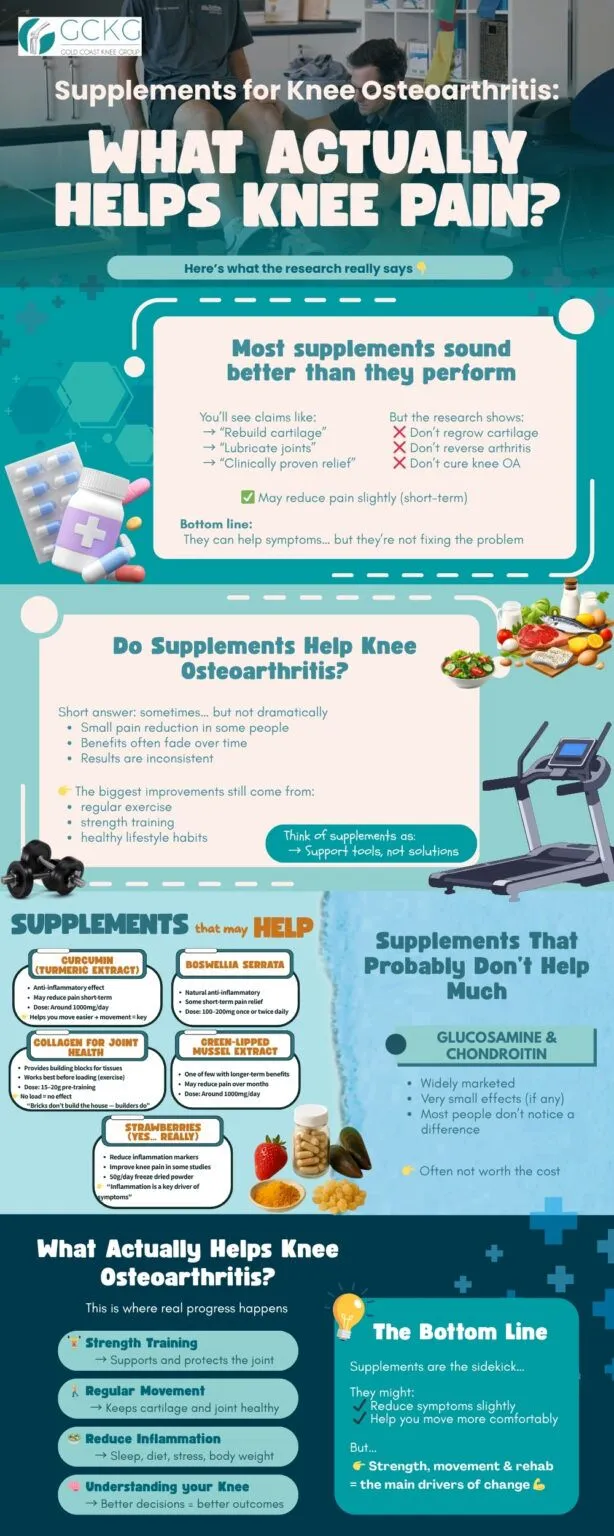
The overall picture is straightforward:
Some supplements help with pain in the short term.
Very few help in the long term.
So if you are looking for a capsule that rebuilds cartilage and fixes the problem, that does not exist. What some of these can do is help symptoms — particularly layered on top of good rehabilitation.
Keep that framing in mind for everything below. These are the last five to ten per cent, not the foundation.
Why "Proven" on a Label Means So Little
One idea explains most of the confusion in this aisle, and it is worth carrying with you.
There is a difference between an effect being statistically significant and an effect being clinically meaningful.
Statistically significant means researchers are confident the effect is real rather than chance. It says nothing whatsoever about size. With enough participants, a tiny effect becomes statistically significant — reliably detectable, and far too small for you to notice.
Clinically meaningful means the change is big enough to matter in your life. Less pain going down stairs. Getting through a shift. Sleeping through.
That distinction is the entire glucosamine story. The review found statistically significant improvements and they were not clinically meaningful, which is how a supplement can be simultaneously "proven to work" in marketing copy and not worth your money.
So when a label says clinically proven, the questions are: proven to do what, by how much, and measured against a placebo or against nothing? Most of the strong-sounding claims quietly fail one of those three.
Curcumin (turmeric extract)
If there is one supplement I am more comfortable recommending, this is it.
Curcumin is the active compound in turmeric and it has solid anti-inflammatory effects. In the review, it showed large short-term pain reductions.
Typical dose: 1000 mg a day, ideally in a formulation designed for better absorption.
What I tell people: it is not instant, it will not regrow cartilage, but it may reduce inflammatory pain enough that you move better. Which, given that moving better is what actually changes the knee, is not nothing.
Collagen
This one is more interesting than it first appears. Collagen hydrolysate showed meaningful short-term pain improvements in the review.
But there is a catch that determines whether it does anything for you. Collagen is a building block, and building blocks do not build anything without a stimulus.
If you are not strength training or otherwise loading the knee, collagen probably will not do much. The stimulus is the active ingredient; the collagen is the raw material.
Typical dose: 15 to 20 g per dose, taken immediately before strength training.
Think of it as a support act rather than the main show.
Boswellia serrata
A herbal extract with anti-inflammatory properties. I was not aware of it until I read the review.
It showed large short-term pain effects, so the evidence supports it. I have not had many patients take it, so I cannot say much from clinical experience — but the data is there.
Typical dose: 100 to 200 mg of standardised extract, once or twice daily.
Green-lipped mussel extract
This one does not get talked about much, and it has a feature that makes it stand out.
Green-lipped mussel extract was one of the very few supplements to show a clinically important reduction in pain at medium-term follow-up — four to six months. Most of the others showed short-term effects only.
Typical dose: 1000 mg a day.
As with Boswellia, I have limited clinical experience with it. But medium-term benefit is genuinely uncommon in this literature, which makes it worth knowing about.
Dried strawberries — yes, really
This one surprises people, and it was not in the systematic review. I have included it because the study behind it was strong enough to be worth knowing about.
A 12-week trial2 in obese adults with knee osteoarthritis found that freeze-dried strawberry powder reduced inflammatory markers and improved pain scores.
Typical dose: 50 g a day of freeze-dried powder.
It reinforces something that matters more than the strawberries themselves: diet matters. The polyphenols in fresh fruit and vegetables are doing real work, and that is a broader point than any single supplement.
Glucosamine and chondroitin
These are the ones almost everybody asks about. Unfortunately the evidence is not strong.
The review did find statistically significant improvements. But they were not clinically meaningful — which is the distinction that matters. A change can be real and reliably measurable while still being too small for you to notice in your life.
Typical doses: glucosamine 1500 mg a day; chondroitin 800 to 1200 mg a day.
What I tell people is this. If you are already taking it and you find it helps, keep taking it. If you are not taking it, I would not bother starting.
The one most people miss: protein
This is not usually filed under supplements, and it may be the most valuable item on this page.
Most older adults under-eat protein. Everyone loses muscle mass with age, and the more you can do to hold onto it, the better.
The connection to your knee is direct. If you do not have muscle, your knee absorbs more load and your function declines. Muscle is the suspension.
What I aim for: 1.2 to 1.6 g per kilogram of body weight per day.
When people increase their protein and strength train, their knee often improves. Those two together do considerably more than anything else on this list.
So What Would I Actually Do?
The order matters more than the choices.
First, the fundamentals. Progressive strength training, adequate physical activity, quality sleep, optimising body composition, and understanding your knee and your pain. These are covered in the three critical ingredients and in reducing inflammation.
Then, once those are in place:
Front line: curcumin and collagen.
Next options: Boswellia extract, green-lipped mussel, dried strawberries.
Do not bother: glucosamine and chondroitin.
Pick one or two rather than stacking them. We do not know what the added benefit of taking several together is, and the cost climbs quickly.
One important note: advice from a qualified dietitian should always be considered, particularly for anyone with complex health needs. Supplements interact with medications and with existing conditions, and that is not something to work out from an article.
The Bottom Line
Supplements are not the foundation of knee osteoarthritis management. They are the final five to ten per cent sitting on top of it.
No capsule will fix the problem. Nothing on this list rebuilds cartilage, and anything marketed on that promise is selling you something the evidence does not support.
But when the fundamentals are genuinely dialled in — you are strength training, moving, sleeping, and you understand what is happening in your knee — the right supplement might give you a useful edge.
The order is the whole point. Supplements on top of the work can help. Supplements instead of the work is money spent on hope.
Want the foundations sorted first?
That is where the return actually is. Our Healthy Knee Program covers strength, activity, inflammation and understanding your knee, starting with a full knee assessment so the program matches what your knee actually needs.
We see patients across the Gold Coast at Robina, Currumbin and Benowa. You can get in touch with our team or phone 0408 051 943.
Frequently Asked Questions about Supplements for Knee Osteoarthritis
🎯 Do any supplements rebuild knee cartilage?
No. Nothing on the market rebuilds cartilage, whatever the packaging says. The systematic review covering 69 trials and 20 supplements found some help with short-term pain and very few help long term.
Supplements are the final five to ten per cent on top of good management, not a treatment in their own right.
🎯 Is turmeric or curcumin good for knee arthritis?
It has the strongest case of the options reviewed. Curcumin, the active compound in turmeric, showed large short-term pain reductions and has solid anti-inflammatory effects.
The typical dose is 1000 mg a day, ideally in a formulation designed for better absorption. It is not instant and it will not regrow cartilage — but it may reduce inflammatory pain enough to help you move better.
🎯 Does collagen help knee pain?
It showed meaningful short-term pain improvements, with one important condition attached.
Collagen is a building block, and building blocks need a stimulus to build anything. If you are not strength training or loading the knee, it probably will not do much. The typical dose is 15 to 20 g taken immediately before strength training.
🎯 Is glucosamine worth taking for knee osteoarthritis?
Probably not, and this is the most common supplement people are already on. The review found statistically significant improvements that were not clinically meaningful — real, measurable, but too small to notice in your life.
My practical advice: if you already take it and find it helps, keep going. If you do not take it, I would not start.
🎯 What about chondroitin?
The same position as glucosamine. Statistically significant but not clinically meaningful improvements in the review.
Typical doses are 800 to 1200 mg a day, but the evidence does not support starting it if you are not already taking it.
🎯 What is green-lipped mussel extract?
A supplement that stands out for an unusual reason — it was one of the very few to show a clinically important reduction in pain at medium-term follow-up, four to six months out. Most supplements only showed short-term effects.
The typical dose is 1000 mg a day.
🎯 Can diet help knee arthritis pain?
Yes, and the strawberry study makes the point neatly. A 12-week trial in obese adults with knee osteoarthritis found freeze-dried strawberry powder reduced inflammatory markers and improved pain scores, at 50 g a day.
The wider lesson is about polyphenols in fresh fruit and vegetables rather than about strawberries specifically. Diet is part of managing your inflammatory load.
🎯 How much protein should I be eating?
Around 1.2 to 1.6 g per kilogram of body weight per day. Most older adults eat considerably less than that.
The link to your knee is direct: everyone loses muscle with age, and without muscle your knee absorbs more load and your function declines. When people increase protein and strength train, the knee often improves.
🎯 Should I take several supplements at once?
Better to pick one or two. We do not know what the added benefit of stacking them is, and the cost adds up fast.
It is also worth speaking to a qualified dietitian, particularly if you have complex health needs or take other medications.
🎯 Do supplements interact with my other medications?
They can. Anti-inflammatory herbal extracts in particular are worth checking against anything you are already taking, and that is a conversation for your GP or pharmacist rather than a label.
Advice from a qualified dietitian should always be considered too, especially if you have complex health needs. None of these is risk-free simply because it is sold without a prescription.
References
1 Liu X, Machado GC, Eyles JP, Ravi V, Hunter DJ. Dietary supplements for treating osteoarthritis: a systematic review and meta-analysis. British Journal of Sports Medicine 2018;52(3):167-175.
2 Schell J, Scofield RH, Barrett JR, et al. Strawberries improve pain and inflammation in obese adults with radiographic evidence of knee osteoarthritis. Nutrients 2017;9(9):949.
3 Arthritis Foundation. Supplement and Herb Guide for Arthritis Symptoms. https://www.arthritis.org/health-wellness/treatment/complementary-therapies/supplements-and-vitamins/supplement-and-herb-guide-for-arthritis-symptoms