

Knee Arthritis Relief: What Actually Works | GCKG
Knee Arthritis Relief: The Three Things That Actually Work
Dr Adam Walker (PhD) — Director and Head of Rehabilitation, Gold Coast Knee Group
If you have knee osteoarthritis, you have probably been handed a version of the same story. Your knee is wearing out. It is age. It will get worse. Manage it as best you can and eventually you will need a replacement.
It is a tidy story. It is also, on the current evidence, largely wrong.
The last few years have seen a genuine shift in how knee arthritis is understood — not a small refinement, but a change in what we think the condition actually is. And that change matters to you, because the old story leads to one set of actions and the new one leads to a completely different set.
This article covers what changed, and the three things that make the biggest difference to how an arthritic knee feels and functions.
None of them is a secret. All three are unglamorous. What is uncommon is doing all three at once, properly, for long enough.
The Old View of Knee Arthritis, and What Replaced It
Knee osteoarthritis is the leading cause of disability in older adults, and a huge cost to the community. It is not a niche problem — and as the population ages, it is growing.
The shift in thinking is best summarised in a table. The left column is what most people were told. The right column is where the evidence now sits.
The old view | The new view |
Knee OA is a problem with the cartilage in your knee | Knee OA involves processes in the knee and in the whole body |
OA is mechanical — wear and tear | OA is a mild whole-body inflammatory process that can show up in any joint, including the knee |
OA is caused by age, injury and overuse | Many things contribute, including what is happening in your knee, your gut, your thoughts and your life |
Nothing much can change it. Exercise only helps early. It will get worse. You will eventually need surgery. | It can be changed. Exercise helps at every stage. It can improve. Surgery can often be avoided. |
That framing comes from The Knee Osteoarthritis Handbook1, written by Moseley, Butler and Stanton — the resource we use with patients because it does the difficult job of translating the science into something usable.
The single most important line in that table is the last one. If you believe the left-hand version, the only rational thing to do is wait. If the right-hand version is closer to the truth, waiting is the worst available option.
A Story You Might Recognise
Let us say Jenny is sitting in front of me. She is in her mid-sixties with aching knees. Her scans show osteoarthritis, and she has been told the knee is wearing out. She is tender around the joint, her muscles ache, and she is carrying a few extra kilos.
She has been told to exercise more. She is worried that exercising a worn-out knee will damage it further. Her brother has had a knee replacement and she has concluded that hers is coming.
Jenny is focused on her knee, which is entirely understandable. It is the bit that hurts.
But Jenny’s knee is part of Jenny. Treating it as a separate mechanical object that has worn out is precisely the thinking that leaves people stuck. Helping her means treating the person, and that is what the new view of osteoarthritis is really saying.
Ingredient One: Activity 🏃♂️➡️
Activity has two halves, and most people only ever get given one of them.
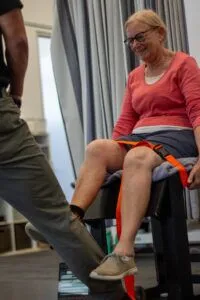
Specific exercise for the muscles that support the knee — squats, calf raises and bridges as a starting point, progressed from there.
General physical activity to lift your overall activity level — walking, cycling, swimming, whatever you will actually keep doing.
When exercise is prescribed properly and matched to the individual, the effects reach well past the knee. It:
Makes you stronger, fitter and more agile
Refreshes your “knee in the brain” — how your nervous system represents and protects the joint
Improves confidence and mood
Improves your ability to learn
Reduces inflammation
Improves your ability to lose weight
Improves your gut microbiome
Improves the other two ingredients — your knowledge and your inflammation
We have written in more detail about how exercise actually helps an arthritic knee, including how to work out how much is right for you.
Ingredient Two: Knowledge 🧠
This is the one that sounds like filler and is not.
People who understand their knee are far more likely to stick with a management plan, and far more likely to get results from it. Understanding your condition:
Helps you solve problems and set sensible goals
Lets you choose the activities that suit you rather than guessing
Reduces your body’s stress response
Helps you sort good advice from bad — and there is a great deal of bad advice about knees
Puts you in charge of your own arthritis rather than waiting on it
Improves the other two ingredients — your activity and your inflammation
There is more on this in our article on managing knee pain through understanding it.
Ingredient Three: Inflammation
This is the most underrated part of knee arthritis management, and the one almost nobody gets told about.
It is not simply about body weight. Fat mass does have a large effect on inflammatory load — but plenty of people carry high inflammation at a perfectly ordinary body weight, and they are often the ones who cannot work out why their knee is so much worse than their scan suggests it should be.
Bringing inflammation down will:
Help you move better
Help you think more clearly and improve memory
Help you lose weight
Make your knee and the rest of you healthier
Improve your body’s ability to adapt to change — which is the whole basis of getting better
Improve the other two ingredients — your activity and your knowledge
We have covered this in depth in how to reduce inflammation in knee osteoarthritis.
Why You Need All Three
You will have noticed the pattern. Every one of the three ingredients improves the other two.
That is not a rhetorical flourish, it is the actual mechanism. Exercise lowers inflammation. Lower inflammation makes exercise feel more tolerable and lets you do more of it. Understanding what is happening reduces the stress response, which lowers inflammation again, and makes you far more likely to keep exercising when the knee has a grumpy week.
One ingredient on its own helps a bit. Two is better. Three is where people get the results that surprise them.
This is also why the standard offering — a printed sheet of exercises and a pamphlet — falls short. It is one ingredient, delivered thinly, with nothing behind it.
I spent a good part of my career in the biomedical version of this. Hands-on treatment of the knee, a few strengthening exercises, some general advice about walking more. It works for some people. It is not the best that can be offered, and for the harder cases it is nowhere near enough.
The Bottom Line
Knee osteoarthritis is not a cartilage problem that happens to be attached to a person. It is a whole-body condition that shows up in the knee.
That reframing is the entire point, because it changes what is worth doing. If your knee is a worn-out part, there is nothing to do but wait for a replacement. If your knee is part of a system that responds to load, to understanding and to your inflammatory state, then there are three levers and all of them are in your hands.
Exercise helps at every stage of osteoarthritis, including the stage you have probably been told is too far gone. Surgery can often be avoided. Things can improve.
That is not optimism. It is what the evidence now says.
Want to know what all three would look like for your knee?
Our Healthy Knee Program for knee osteoarthritis is built around these three ingredients rather than around a sheet of exercises. It starts with a full knee assessment so we can measure what is actually going on, then matches the program to what we find.
We see patients across the Gold Coast at Robina, Currumbin and Benowa. You can get in touch with our team or phone 0408 051 943.
FAQs About Knee Arthritis Relief
❓ Is knee osteoarthritis just wear and tear?
No, and this is the single most important thing to unlearn. The current understanding is that osteoarthritis is a mild whole-body inflammatory process that can appear in any joint, rather than a purely mechanical wearing away of cartilage.
That matters practically. If it were only wear and tear, using the knee would make it worse. Because it is not, the knee responds to being used well — and to a great many things happening elsewhere in your body.
❓ Can knee arthritis get better, or does it only get worse?
It can improve. The old model treated osteoarthritis as a one-way street ending in a joint replacement, and that model is being replaced.
There are things you can do to slow its progress, exercise helps at every stage rather than only the early ones, symptoms can improve, and surgery can often be avoided.
❓ What are the three critical ingredients for knee arthritis?
Activity, knowledge and inflammation. Activity covers both specific exercise for the knee and your general physical activity level. Knowledge is understanding your own condition well enough to make good decisions about it. Inflammation is your body’s overall inflammatory load.
Each one improves the other two, which is why doing all three together produces results that any one of them alone does not.
❓ Will exercise damage my worn-out knee?
This is the most common fear and the biggest single barrier. The evidence does not support it — exercise is recommended at every stage of osteoarthritis, including when scans look severe.
A knee that is never loaded is not a protected knee. It loses the muscle support, the fluid exchange and the tolerance that keep it working.
❓ Does losing weight fix knee arthritis?
It helps, but framing it purely as a weight issue misses most of the picture. Excess body fat matters largely because it raises systemic inflammation, not only because of the extra load through the joint.
It also means people at an average body weight can still have a high inflammatory load — and can get significant benefit from addressing it.
❓ Why does my scan look bad when my knee feels fine, or the reverse?
Because the scan is measuring one thing and your experience is produced by several. Two people with identical X-rays can function completely differently.
Inflammation, sleep, stress, muscle strength and what you believe about your knee all feed into how much pain you have and how much the knee can do. The picture is only part of it.
❓ Do I have to accept that I will eventually need a knee replacement?
No. That belief is part of the old model and it is deeply embedded — in the community and in parts of the health system.
Some people do go on to have a replacement, and for some it is the right decision. But arriving there without ever having properly tried the alternatives is a very different situation from arriving there having done the work.
❓ Is it too late for me to start?
Almost certainly not. Exercise helps at all stages of osteoarthritis, which includes the stage where you have been told there is nothing left to do.
The best time to start is well before a replacement is on the table, but starting later is still considerably better than not starting.
❓ Why do a few exercises from a physio sheet not seem to work?
Because it is one ingredient out of three, usually delivered without enough load, without progression, and without anything addressing knowledge or inflammation.
The exercises themselves may be perfectly reasonable. The problem is that they are being asked to do a job that needs the other two ingredients alongside them.
References
1 Moseley GL, Butler DS, Stanton TR. The Knee Osteoarthritis Handbook. Noigroup Publications, 2023. https://www.noigroup.com/product/knee-osteoarthritis-handbook/