


Knee Injections for Osteoarthritis | GCKG
Knee Injections for Osteoarthritis: What Each One Does and When It Helps
Dr Adam Walker (PhD) — Director and Head of Rehabilitation, Gold Coast Knee Group
If your knee arthritis is not settling, someone will eventually mention an injection. Cortisone, maybe. Or PRP, which you will have read something about online. Possibly hyaluronic acid.
They are not the same thing, they do not do the same job, and the evidence behind them varies considerably.
The most useful thing to understand before any of that detail: injections are symptom-control tools. They do not cure osteoarthritis and they do not reverse it. Anyone telling you otherwise is overselling.
What they can do is take enough pain out of the way that you can actually do the things that change the knee — and for some people, that is genuinely valuable.
This article walks through the four main options. It comes out of a presentation by Dr Luke Eggleston, a Sports and Exercise Physician from SEQSEM, at our Mastering Knee OA for GPs evening, reshaped for people who are weighing this up for their own knee.
Where Injections Actually Fit 💉
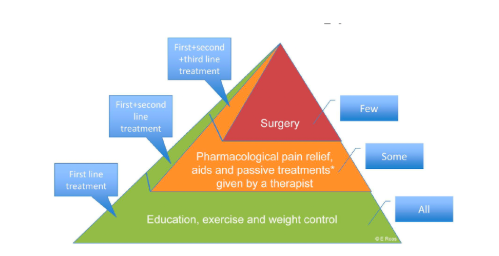
Osteoarthritis is a whole-joint disease. Cartilage, bone, the synovium, ligaments and neuromuscular control all contribute to it. So management should be layered, and injections are not first-line.
Picture a pyramid.
The base — for everyone
Education, pacing your activity, physiotherapy and exercise therapy, weight management
Simple pain relief, as appropriate for you
Adjuncts — bracing, taping, footwear, modifying how you load the knee
The middle — where injections sit
Injections into the joint — corticosteroid, hyaluronic acid, PRP
Radiofrequency ablation, for advanced cases in people who are not surgical candidates
The aim at this level is to reduce pain, improve function, lower how much medication you need, and either delay surgery or bridge you toward it.
The top — for selected people
Surgery — joint replacement, or joint-preserving procedures
The key principle: use injections when the base strategies are not enough, but before committing to surgery. What they should never be is a substitute for the base — because the base is what actually changes your knee’s capacity. There is more on that in the three critical ingredients of knee arthritis management.
Corticosteroid - Cortisone Injections
How it works. A potent anti-inflammatory delivered inside the joint, reducing inflammation of the joint lining and the pain that comes with it.
When it is used. Inflammatory flares, when there is synovitis, when rapid relief is the priority, or as bridging relief before a joint replacement.
Benefits. Fast — working within days. Cheap. Widely available.
Limitations. Short-lived, generally weeks rather than months. Plenty of people do not respond at all. It is contraindicated within three to six months of surgery. It is not disease-modifying. And clinicians need to be cautious about the potential harms of repeated use, which is the main reason this is not something to keep going back for.
Hyaluronic Acid - Viscosupplementation
How it works. Restores lubrication and viscoelasticity in the joint, and may stimulate your own production of hyaluronic acid.
When it is used. Mild to moderate osteoarthritis, where anti-inflammatory medication is being avoided, or where steroids are not appropriate.
Benefits. Onset around two to four weeks, lasting roughly six months, with a good safety profile.
Limitations. This is the important one — most current guidelines recommend against it, on the grounds of lack of effect. Post-injection flares occur in 5 to 10% of people, cost varies, and it is not disease-modifying.
So it appears on the list because it exists and you will hear about it, not because it comes recommended.
Platelet-Rich Plasma (PRP)
How it works. Your own blood, concentrated for platelets, growth factors and anti-inflammatory mediators, then injected into the joint. The idea is to shift the environment inside the knee toward repair.
When it is used. Early to moderate osteoarthritis in active people, where anti-inflammatory medication is being avoided, and where surgery is not yet on the table.
Benefits. Longer-lasting than hyaluronic acid or steroids — six to twelve months or more — and repeatable.
Limitations. The dose matters, which means a 30 to 60 mL blood draw is needed. There is no Medicare rebate. It is not immediate. And it is not disease-modifying.
The dose problem, which explains a lot of confusion
Not all PRP is the same, and the dose of platelets — not just the concentration — appears to be what determines whether it works.
High-dose PRP, around 10 billion platelets, has the strongest evidence for sustained improvements in pain and function.
The RESTORE trial1, a large randomised controlled trial, found PRP no better than saline. It used a low-dose system — an 8 to 10 mL blood draw with minimal platelet yield. The trial was methodologically sound; the under-dosing likely explains the result.
Systematic reviews consistently show that when the low-dose studies are excluded, the evidence for PRP is considerably stronger.
The practical implication: if you are considering PRP, the system being used matters enormously. Ask whether it delivers a genuinely platelet-rich product at sufficient dose. Otherwise you may be paying for glorified plasma.
Genicular Nerve Radiofrequency Ablation
How it works. Radiofrequency heat is used to disrupt the sensory nerves supplying the knee — usually around six genicular nerve branches — after a diagnostic block confirms they are the right target. Ultrasound guidance is ideal.
When it is used. Moderate to severe osteoarthritis. It is particularly well suited to people who are not surgical candidates, or as a bridge before an operation.
Benefits. Relief within about two weeks, lasting six to eighteen months. It reduces how much pain medication is needed, has a good safety profile, and can be repeated. The diagnostic block also helps distinguish pain coming from the joint itself from pain driven by a sensitised nervous system, which is useful information in its own right.
Limitations. It requires a specialist referral and a practitioner trained in nerve ablation. And the effect wanes over time.
What an Injection Cannot Do
Worth stating plainly, because the marketing around some of these is enthusiastic.
None of the four options here is disease-modifying. Not cortisone, not hyaluronic acid, not PRP, not nerve ablation. Every one of them changes how the knee feels. None of them changes the underlying condition.
They also do not build strength, they do not improve your fitness, and they do not change how confident you feel using the knee. Those three are what determine how much your knee will tolerate in six months, and no needle touches any of them.
There is one more thing worth knowing. Pain that has been suppressed can let you do more than your knee is currently conditioned for, which is its own risk. The window an injection opens is best spent building capacity under guidance rather than testing the limits of a joint that only feels ready.
When I Would Actually Suggest One
Speaking clinically and personally, there are three situations where I raise injections:
You need pain relief for a specific event — a holiday, a wedding, something you cannot move. Cortisone, with a clear understanding that the benefit is short-term.
You cannot make progress because of pain. PRP, delivered at high dose by a specialist practitioner, with a clear understanding that results vary and that there is a cost involved.
You need a knee replacement but are not a surgical candidate for other medical reasons. Radiofrequency ablation, understanding that it can give significant relief, that some people do not respond, and that the effect wears off after six to eighteen months.
Notice what is common to all three. Each is a specific problem with a specific tool, and in every case the honest conversation about what it will and will not do happens before the needle does.
None of them replaces the work. If an injection buys you three months of tolerable pain and you spend those three months doing nothing different, you arrive back where you started with less money.
The Bottom Line
Injections for knee osteoarthritis are tools for symptom control. They are not cures.
Their proper role is threefold: to make physical activity and exercise therapy possible, to buy time before surgery, and to reduce how much medication you rely on.
That first one is the most valuable and the most often missed. An injection that gets you into a program you could not otherwise tolerate has done something genuinely useful. An injection given instead of that program has not.
If you are weighing one up, the questions worth asking are: what specifically is this for, how long should it last, what happens when it wears off, and what am I going to do with the window it gives me.
Not sure whether an injection is the right next step?
The most useful thing is usually to know how much room is left in the base of the pyramid before moving up it. Our Healthy Knee Program starts with a full knee assessment that measures where your knee actually is, and we work alongside sports physicians when an injection genuinely is the right call.
We see patients across the Gold Coast at Robina, Currumbin and Benowa. You can get in touch with our team or phone 0408 051 943.
FAQs About Knee Injections for Osteoarthritis
🎯 Do knee injections cure arthritis?
No. Every option covered here is a symptom-control tool, and none of them is disease-modifying. They do not cure or reverse osteoarthritis.
What they can do is reduce pain enough that you can do the things that genuinely change your knee’s capacity — which is where the durable improvement comes from.
🎯 How long does a cortisone injection last in the knee?
Typically weeks rather than months, and it works quickly — within days. A good number of people do not respond at all.
That short duration is why it suits a specific purpose, such as getting through an event or bridging toward surgery, rather than being a management strategy.
🎯 Is it safe to have repeated cortisone injections?
Caution is warranted with repeated use, and the potential harms are a genuine consideration rather than a formality.
It is also contraindicated within three to six months of surgery, which matters if a joint replacement is on your horizon. This is a conversation for the doctor giving the injection.
🎯 Does PRP work for knee osteoarthritis?
The evidence depends heavily on the dose. High-dose PRP — around 10 billion platelets — has the strongest evidence for sustained improvements in pain and function.
The large RESTORE trial found PRP no better than saline, but it used a low-dose system with an 8 to 10 mL blood draw and minimal platelet yield. Systematic reviews show the evidence is considerably stronger when low-dose studies are excluded.
🎯 What should I ask before having PRP?
Whether the system being used delivers a genuinely platelet-rich product at sufficient dose. A 30 to 60 mL blood draw is needed to get there.
Also worth asking: there is no Medicare rebate, the effect is not immediate, and results vary between people. Those are all reasonable things to have clear before committing.
🎯 Is hyaluronic acid worth having?
Most current guidelines recommend against it, on the basis of lack of effect. That is the most important thing to know about it.
It has a good safety profile and lasts around six months when it does help, with post-injection flares in 5 to 10% of people. But the guideline position is what it is.
🎯 What is radiofrequency ablation for the knee?
Radiofrequency heat is used to disrupt the sensory nerves supplying the knee — usually about six genicular nerve branches — after a diagnostic block confirms the target.
Relief typically comes within two weeks and lasts six to eighteen months. It suits moderate to severe arthritis, particularly in people who are not surgical candidates.
🎯 Which knee injection lasts the longest?
Radiofrequency ablation gives the longest window at six to eighteen months, followed by PRP at six to twelve months or more. Hyaluronic acid lasts around six months where it works, and cortisone is the shortest at weeks.
Longer is not automatically better. The right choice depends on what you need it to do and where you are in the overall picture.
🎯 Should I have an injection instead of exercise?
No, and this is the point most worth taking from this article. Education, exercise therapy, activity pacing and weight management sit at the base of the pyramid for everyone.
Injections belong in the middle, for when the base is not enough on its own. An injection given in place of that work buys a window and wastes it.
References
1 Bennell KL, Paterson KL, Metcalf BR, et al. Effect of intra-articular platelet-rich plasma vs placebo injection on pain and medial tibial cartilage volume in patients with knee osteoarthritis: the RESTORE randomized clinical trial. JAMA 2021;326(20):2021-2030.