


Why Knee Pain Changes Day to Day | GCKG
Why Your Knee Hurts: The Real Reason Knee Pain Changes Day to Day
Dr Adam Walker (PhD) — Director and Head of Rehabilitation, Gold Coast Knee Group
Here is a puzzle worth sitting with.
Some people have knees that look dreadful on a scan — grade 4 osteoarthritis, joint space gone, osteophytes everywhere — and they feel fine. They walk, they garden, they get on with it.
Others have barely a whisper of change on their imaging and are in pain every day.
If arthritis were simply about how worn the joint is, neither of those should be possible. Both are common.
The explanation is that knee pain is not really about the knee. It is about the whole person — and once you understand that, a great deal about your own knee stops being mysterious.
What Actually Shapes Your Pain
Your experience of pain, particularly in something like knee osteoarthritis, is shaped by a long list of things:
Your exercise habits
Your diet and nutrition
Systemic inflammation
Stress and anxiety
Sleep quality
Your strength, mobility and general fitness
What you believe and understand about your own condition
Every one of these influences two things: how much load your knee can tolerate, and how sensitive the system becomes.
Which is why managing knee arthritis is not a matter of prescribing squats. It is a matter of understanding something called allostatic load.
What Allostatic Load Means
Allostatic load is the cumulative burden that chronic stress and life events place on your body’s systems. It is the total stress your body is currently carrying.
Importantly, that stress is not only emotional. It includes:
Poor sleep and inadequate recovery
Low physical activity
Chronic inflammation
Anxiety and depression
Poor diet and metabolic health
When these accumulate, they change how your body regulates itself — including how your nervous system processes pain. In someone carrying a high allostatic load, the nervous system becomes more reactive, the immune system stays switched on, and pain thresholds drop.
The Knee Osteoarthritis Handbook1 by Moseley, Butler and Stanton sets out strong evidence that this model explains why pain persists, and why it varies so much between people with near-identical scans. It underpins the education in our own program.
The Bucket
This is the analogy that lands with people more reliably than anything else I use.
Imagine your knee’s ability to handle activity is a bucket.
The size of the bucket is your knee’s capacity to tolerate load.
The water in the bucket is every stressor your body is currently under — poor sleep, low fitness, high inflammation, physical activity, mental stress, lack of knowledge, poor diet, fear of movement.
Pain happens when the bucket overflows.
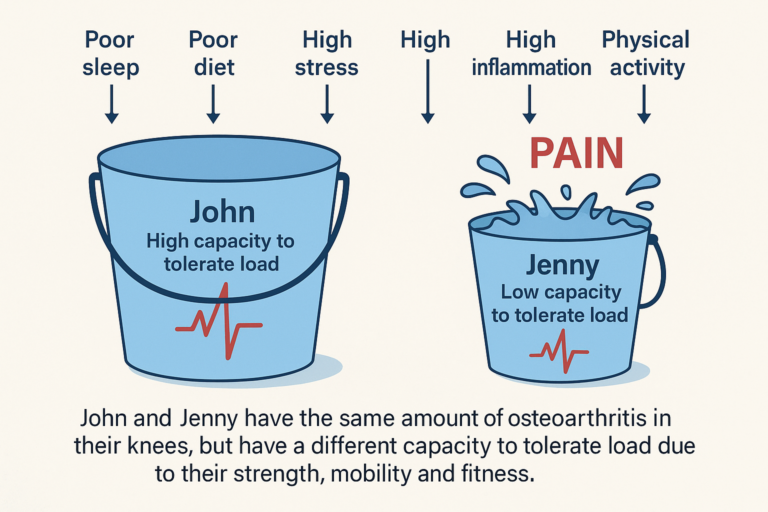
Some people have a very small bucket, through weakness, stiffness or poor general conditioning. Others have a very full one — high inflammation, elevated stress, daily habits that are not supporting recovery.
And if the bucket is already near the brim from everything else in life, it does not take much to spill it. A walk around the block. A gym session done poorly. One bad night’s sleep.
That is why your knee can feel fine on Tuesday and wretched on Thursday with nothing having changed inside the joint. Nothing about the structure changed. The water level did.
Same Knee, Different Lives
John and Jenny are both 65. Their imaging shows moderate osteoarthritis on the inside of the knee — grade 3 on the radiology report for both of them.
That is where the similarity ends.
John walks daily and does strength training twice a week. He eats well, sleeps well, and manages stress through social contact and some mindfulness. He reports occasional stiffness in the knee and no significant pain. He hikes, he plays with his grandchildren, he moves freely.
Jenny struggles. She sleeps poorly, works long hours in a stressful job, has little time for exercise and eats on the run. She has daily knee pain, and it flares with things as ordinary as walking to the shops or getting out of the car.
Structurally their knees are the same. Their capacity to tolerate load — their bucket size — is not remotely the same.
John’s bucket is large and only half full. His strength, mobility and fitness give him a high load capacity, and his pain is minimal.
Jenny’s bucket is small and overflowing. Her pain is not caused by damage alone. It comes from a high allostatic load built out of lifestyle, stress, inflammation and inactivity.
If you read that and recognised yourself as Jenny, the useful part is this: almost everything filling her bucket is modifiable. Almost nothing about the grade 3 on her report is.
What To Do About It
There are only two moves available, and you want both.
1. Make the bucket bigger
Improve your strength, mobility and fitness
Rebuild confidence in movement
Build capacity over time, so the knee tolerates more before it reaches the pain threshold
This is the exercise side, and how to do it properly is covered in how exercise helps knee osteoarthritis.
2. Take water out of the bucket
Improve sleep and recovery
Make dietary changes that reduce inflammation
Manage systemic inflammation through lifestyle and activity
Address fear, improve your knowledge, and reduce the threat signals reaching your nervous system
This is the part that gets left out of most knee treatment entirely, and it is often where the biggest and fastest gains are — particularly for anyone whose bucket is overflowing rather than small. There is more detail in reducing inflammation in knee osteoarthritis.
Both moves together are the philosophy behind our program, which targets the three critical ingredients: activity through tailored progressive exercise, inflammation through lifestyle, dietary and sleep strategies, and knowledge through reframing pain and reducing fear.
Capacity and load. You want to be working on both sides of the equation, and most people have only ever been offered one.
Using the Bucket on a Bad Week
The model is only useful if it changes what you do when the knee is sore. So here is how to actually use it.
When your knee flares, the instinctive question is what did I do to it? — and the search usually lands on whatever exercise you did most recently. That is almost always the wrong suspect, because the exercise was the last drop rather than the water.
The better question is what is in my bucket at the moment? Look at the week behind you. How have you slept? What has been happening at work or at home? Have you been eating properly, or on the run? Have you been sitting more than usual? Is anything else in your body flaring?
Very often the answer is obvious once you look, and it has nothing to do with your knee.
That reframe does two useful things. It stops you abandoning the exercise that was actually helping, which is the single most common way people go backwards. And it points you at the thing that would genuinely lower the water level this week — which might be going to bed earlier rather than doing anything to the knee at all.
A flare is information about your total load. Treat it that way and it becomes something you can work with rather than something that happens to you.
The Bottom Line
Your knee pain varies because your total load varies. Not because your joint is deteriorating and recovering week to week — it is not doing that.
The bucket gives you a way to make sense of a bad week without concluding that something has gone wrong inside the knee. A stressful month at work and some poor sleep, and a knee that was fine in June starts complaining, with nothing structural having changed at all.
It also gives you somewhere to act. You cannot change the grade on your radiology report. You can change how much water is in your bucket, and you can make the bucket bigger.
The most valuable thing this model offers people is not a technique. It is the confidence that their pain is changeable — which, once someone genuinely believes it, changes what they are willing to try.
Want to work on both sides of the equation?
Our Healthy Knee Program is built around exactly this — building capacity through tailored exercise while working on the sleep, inflammation and understanding that determine how full your bucket is. It starts with a full knee assessment that looks at your knee and at everything around it.
We see patients across the Gold Coast at Robina, Currumbin and Benowa. You can get in touch with our team or phone 0408 051 943.
📝 FAQs About Why Knee Pain Varies
❓Why does my knee hurt more some days than others?
Because the total load your body is carrying changes daily, even when your knee does not. Sleep, stress, inflammation, activity and how you are feeling about the knee all feed into it.
Think of it as a bucket. Pain happens when it overflows — and a bad night’s sleep or a stressful week can raise the water level enough that an ordinary walk tips it over.
❓Does a flare-up mean my knee is getting worse?
Generally no. A flare is usually the bucket overflowing, not the joint deteriorating.
Structural change happens over years, not between Tuesday and Thursday. If your knee felt fine last week and awful this week, something about your total load changed rather than something about your cartilage.
❓Why does my friend have a worse scan but less pain than me?
Because you have different bucket sizes and different water levels. Two people with identical grade 3 osteoarthritis can function completely differently.
The person with more strength, better sleep, lower inflammation and more confidence in their knee has more capacity and less load. Their structure may be worse and their experience much better.
❓What is allostatic load?
The cumulative burden of chronic stress and life events on your body’s systems — the total stress your body is under.
It is not only emotional. Poor sleep, low physical activity, chronic inflammation, anxiety and depression, and poor diet and metabolic health all contribute to it.
❓Does stress actually make knee pain worse?
Yes, through a real physiological pathway rather than a psychological one. When allostatic load accumulates, the nervous system becomes more reactive, the immune system stays activated, and pain thresholds drop.
So a stressful period genuinely lowers the amount of load your knee will tolerate before it becomes painful.
❓Does poor sleep affect knee pain?
Considerably. Sleep sits on the list of things that raise allostatic load, and it is one of the more powerful ones.
It is also one of the most modifiable, which makes it a good early target for anyone whose bucket is overflowing rather than small.
❓How do I make my knee tolerate more?
Two ways, and you want both. Make the bucket bigger by improving strength, mobility and fitness, and by rebuilding confidence in movement.
And take water out of the bucket by improving sleep, addressing inflammation through diet and activity, and reducing the fear and uncertainty that keep the nervous system on alert.
❓Is my knee pain in my head?
No. This is the most important thing to be clear about. Your pain is real, and the mechanisms described here are physiological — nervous system reactivity, immune activation, inflammatory load.
Saying pain is influenced by sleep and stress is not the same as saying it is imagined. It is saying the system that produces pain responds to more inputs than the state of your cartilage.
❓Can my knee pain actually improve?
Yes, and that is the practical value of this model. You cannot change the grade on your radiology report, but you can change almost everything that determines your bucket size and your water level.
Both sides of the equation are modifiable, which is why pain can improve substantially in a knee whose structure has not changed at all.
References
1 Moseley GL, Butler DS, Stanton TR. The Knee Osteoarthritis Handbook. Noigroup Publications, 2023. https://www.noigroup.com/product/knee-osteoarthritis-handbook/